


Viibryd (vilazodone) and Zoloft (sertraline) both raise serotonin activity, but Viibryd adds a second mechanism and one critical rule that Zoloft does not have: it must be taken with food. Viibryd is a newer, narrower-indication drug approved only for major depressive disorder, while Zoloft covers a wider range of anxiety-related conditions. This guide compares their mechanisms, the food requirement, dosing, side effects, and what marketing claims about “fewer sexual side effects” actually rest on.
This is general information, not medical advice. Ask your prescriber which antidepressant fits your diagnosis and history.
Viibryd vs Zoloft at a glance
| Viibryd (vilazodone) | Zoloft (sertraline) | |
|---|---|---|
| Drug class | SSRI plus 5-HT1A receptor partial agonist (SPARI) | SSRI |
| FDA-approved for | Major depressive disorder (adults) only | MDD, OCD, panic disorder, PTSD, social anxiety disorder, PMDD |
| Must be taken with food | Yes; without food, absorption drops by roughly 50% (peak level) and 60% (concentration), risking inadequate treatment | No specific food requirement |
| Common side effects | Diarrhea (~28% in trials), nausea (~23%), insomnia, vomiting | Diarrhea, nausea, insomnia, sexual side effects |
| Pediatric approval | Not approved in pediatric patients | OCD only |
| Approved since | 2011 | 1991 |
What each is approved for
Viibryd has one FDA-approved use: major depressive disorder in adults. It is not approved for anxiety disorders, OCD, or any pediatric use.
Zoloft covers major depressive disorder, obsessive-compulsive disorder, panic disorder, post-traumatic stress disorder, social anxiety disorder, and premenstrual dysphoric disorder in adults, plus OCD in children.
If the diagnosis is anything other than straightforward MDD, Zoloft has an approved pathway that Viibryd does not.
How they work: one mechanism vs two
Zoloft is a standard SSRI: it blocks the reuptake of serotonin, leaving more available at nerve synapses.
Viibryd does that too, but its label describes an additional action: vilazodone also binds selectively with high affinity to 5-HT1A receptors and is a 5-HT1A receptor partial agonist, earning it the informal class name “serotonin partial agonist-reuptake inhibitor” (SPARI). The label is careful to note that the net result of this partial agonist action on serotonergic transmission, and its actual role in vilazodone’s antidepressant effect, are unknown. In other words, the extra mechanism exists and is measurable in the lab, but its clinical significance for how well the drug works has not been established. This distinguishes marketing language (“dual mechanism”) from what the label itself commits to.
The food requirement: Viibryd’s defining practical difference
This is the single most important practical fact about Viibryd. The absolute bioavailability of vilazodone is 72% with food. Without food, vilazodone’s peak concentration and total exposure can drop by approximately 60% and 50% respectively compared with the fed state, and administration without food can result in inadequate drug concentrations, meaning the dose effectively becomes too low to treat depression properly.
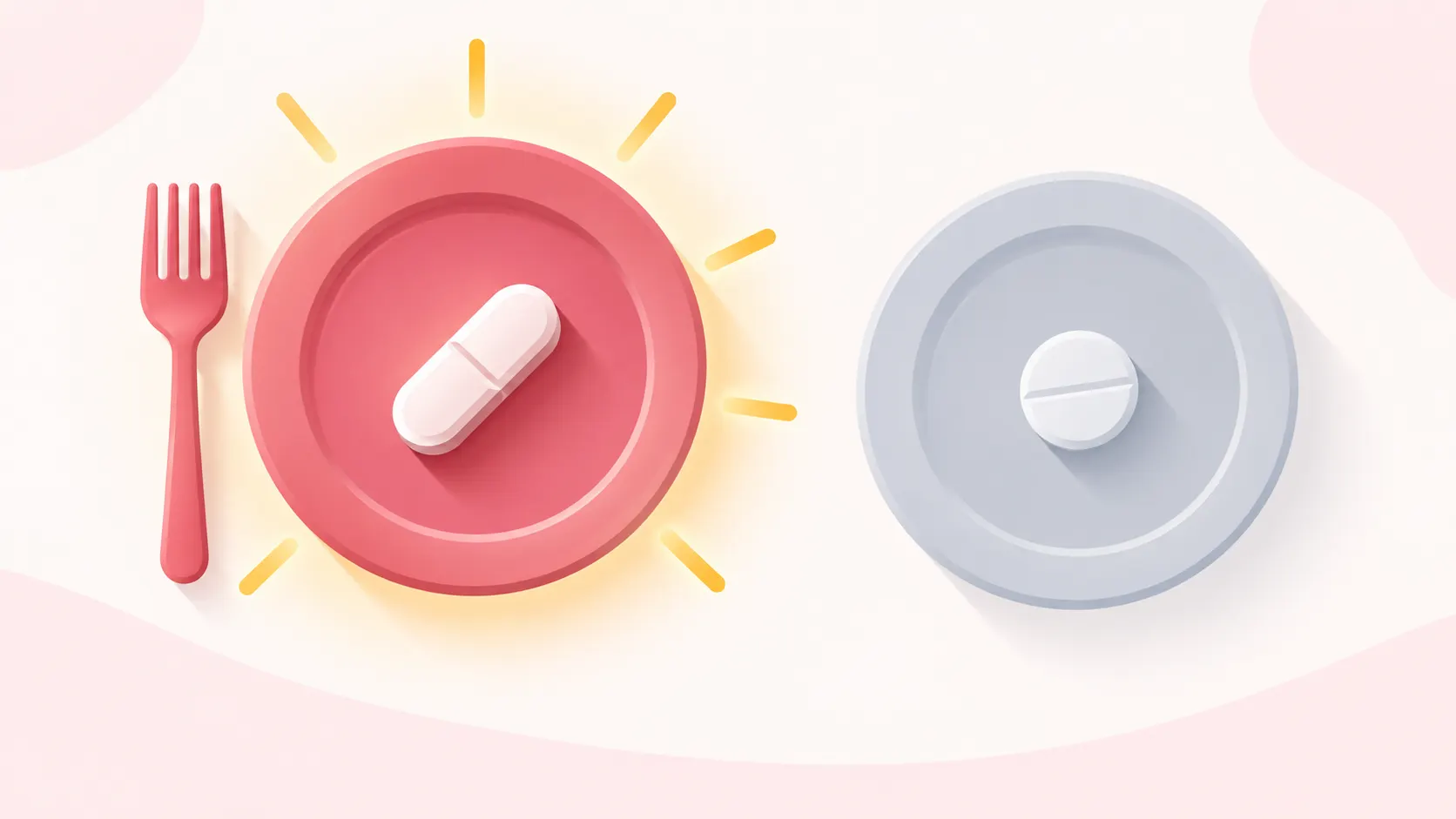
This means:
- Viibryd must be taken with a meal every single time, not just occasionally.
- Skipping food with a dose is not a minor inconvenience; it can mean the day’s dose does not work as intended.
- Zoloft has no comparable food requirement and can be taken with or without food.
If you are prescribed Viibryd, build “always with food” into your routine as firmly as the dose itself.
Dosing
Viibryd is started at 10 mg once daily with food for the first 7 days, increased to 20 mg once daily with food for the next 7 days, and then to the target maintenance dose of 40 mg once daily with food. This gradual titration is standard and designed to reduce gastrointestinal side effects, which are the most common early complaint.
Zoloft starts at 50 mg once daily for most adult indications, with adjustments based on response and tolerability, up to typical maximums around 200 mg depending on the condition.
Side effects
Viibryd’s most common adverse reactions in its pivotal trials (occurring in 5% or more of patients and at least twice the placebo rate) were diarrhea (28%), nausea (23%), insomnia (6%), and vomiting (5%). Diarrhea and nausea are notably prominent with vilazodone compared with many other antidepressants, likely related to its additional serotonergic activity in the gut.
Zoloft’s most common adverse reactions include nausea, diarrhea, tremor, dyspepsia, decreased appetite, increased sweating, and sexual side effects (ejaculation failure, decreased libido).
The sexual side effect question
Viibryd is sometimes marketed or discussed online as having fewer sexual side effects than standard SSRIs, based on its added 5-HT1A partial agonist activity, a mechanism shared conceptually with some other newer antidepressants believed to reduce sexual dysfunction. However, the FDA label for Viibryd does not make a specific comparative claim that it causes fewer sexual side effects than sertraline or other SSRIs, and comparative data directly measuring this against sertraline specifically is limited. Direct comparative data exists more robustly for other pairs, such as vortioxetine (Trintellix) versus escitalopram, where a 2022 study found vortioxetine specifically superior for sexual desire, arousal, and orgasm phases. Whether vilazodone shares a similar advantage over sertraline specifically has not been established with comparable rigor, so treat any claim of “fewer sexual side effects” for Viibryd versus Zoloft as an unproven inference rather than a demonstrated fact, pending better head-to-head data.
Drug interactions and safety warnings
Both carry the boxed warning for increased suicidal thoughts and behaviors in patients under 25, standard for antidepressants. Both interact with other serotonergic drugs (MAOIs, other SSRIs/SNRIs, triptans, tramadol, buspirone, St. John’s wort), raising serotonin syndrome risk, and both increase bleeding risk when combined with NSAIDs, aspirin, or anticoagulants.
Viibryd’s label notes that removal by dialysis has not been studied, and its high volume of distribution suggests dialysis would not effectively reduce blood levels in an overdose situation. Zoloft’s oral solution contains 12% alcohol and is contraindicated with disulfiram; Viibryd tablets carry no such alcohol content warning.
Cardiac electrophysiology testing for Viibryd found that treatment did not prolong the QTc interval, a point specifically noted in its label, unlike escitalopram (Lexapro), which does carry a dose-related QT warning.
What the evidence says about efficacy
Viibryd’s approval rested on two 8-week, placebo-controlled trials in adults with MDD, measuring improvement using the Montgomery-Asberg Depression Rating Scale (MADRS). In both trials, vilazodone provided superior improvement compared with placebo. This establishes that Viibryd works better than doing nothing, which is the FDA approval bar, but these trials did not compare vilazodone directly against sertraline or another active antidepressant, so there is no head-to-head efficacy data specifically pitting Viibryd against Zoloft.
Zoloft has a much longer track record, having been studied and used since 1991, with efficacy data across a wider range of conditions given its broader indication list. In large pooled comparisons of multiple antidepressants, such as the 2018 Cipriani network meta-analysis, sertraline ranked favorably on the combined measure of efficacy and tolerability among 21 antidepressants studied, while vilazodone (studied less extensively given its more recent approval) generally ranked in a middle range, neither a standout nor a weak performer.
Practical tips if you are taking Viibryd
- Set a reminder tied to a meal, not just a time of day, since the food requirement is not optional.
- A full meal is not always required, but the label’s data was generated with food, so a reasonable snack rather than an empty stomach is the safer approach if a full meal is not practical.
- Expect gastrointestinal side effects early. The titration schedule (10 mg, then 20 mg, then 40 mg over three weeks) is designed to ease this, but diarrhea and nausea are still the most commonly reported reasons people stop the drug.
- Give it the full 8 weeks before judging effectiveness, matching the timeframe used in its approval trials.
- Do not double up if you miss a dose with food; wait for your next scheduled dose with your next meal.
Practical tips if you are taking Zoloft
- No food timing rule, which makes it easier to fit into an irregular schedule.
- Take it at a consistent time of day to minimize day-to-day fluctuation, since its half-life (about 26 hours) is shorter than some other SSRIs.
- Watch for GI side effects too, though generally reported at somewhat lower rates than Viibryd’s trial data, individual experience varies.
- If using the oral solution, remember it contains alcohol and is incompatible with disulfiram.
Who each might suit
Factors that may point toward Viibryd:
- A straightforward MDD diagnosis with no anxiety-disorder component needing separate treatment
- Reliable, consistent meal timing that makes the food requirement manageable
- A history of sexual side effects on standard SSRIs, where a trial of a different mechanism may be considered, understanding the comparative evidence versus sertraline specifically is limited
Factors that may point toward Zoloft:
- OCD, panic disorder, PTSD, or social anxiety disorder as the diagnosis
- Irregular eating patterns that would make Viibryd’s food requirement hard to follow reliably
- A need for a pediatric option (Zoloft has one for OCD; Viibryd has none)
- A longer track record and more extensive real-world safety data, since Zoloft has been marketed since 1991 versus Viibryd’s 2011 approval
Frequently asked questions
Does Viibryd really need to be taken with food every time?
Yes. The label states that administration without food can result in inadequate drug concentrations, meaning the dose may not work properly without food. This is a firm rule, not a suggestion.
Is Viibryd better than Zoloft for sexual side effects?
This is commonly claimed but not established with strong head-to-head data specifically comparing vilazodone and sertraline. The label does not make this comparative claim. Related drugs like Trintellix have better-documented sexual side effect advantages over other SSRIs in direct trials.
Can Viibryd treat anxiety?
It is only FDA-approved for major depressive disorder, not for any anxiety disorder. Zoloft has approvals for several anxiety-related conditions.
Why does Viibryd cause so much diarrhea and nausea?
Its added serotonergic activity, including at 5-HT1A receptors, is thought to contribute to a higher rate of gastrointestinal side effects (28% diarrhea, 23% nausea in trials) compared with many standard SSRIs.
Is Viibryd a new type of drug?
It combines standard SSRI activity with 5-HT1A receptor partial agonism, informally called a SPARI. The label is explicit that the clinical importance of the added mechanism for the antidepressant effect is unknown.
Which has been available longer, Viibryd or Zoloft?
Zoloft was approved in 1991; Viibryd was approved in 2011, twenty years later.
References
- FDA. VIIBRYD (vilazodone hydrochloride) tablets, full prescribing information (2017).
- FDA. VIIBRYD prescribing information (2015): dialysis and pharmacokinetics.
- Cruz MP. Vilazodone HCl (Viibryd): a serotonin partial agonist and reuptake inhibitor for the treatment of major depressive disorder (PMC, 2012).
- FDA. ZOLOFT (sertraline hydrochloride) label (2016).
- Antidepressants and sexual dysfunction: is vortioxetine different? SAGE journals, 2022.