

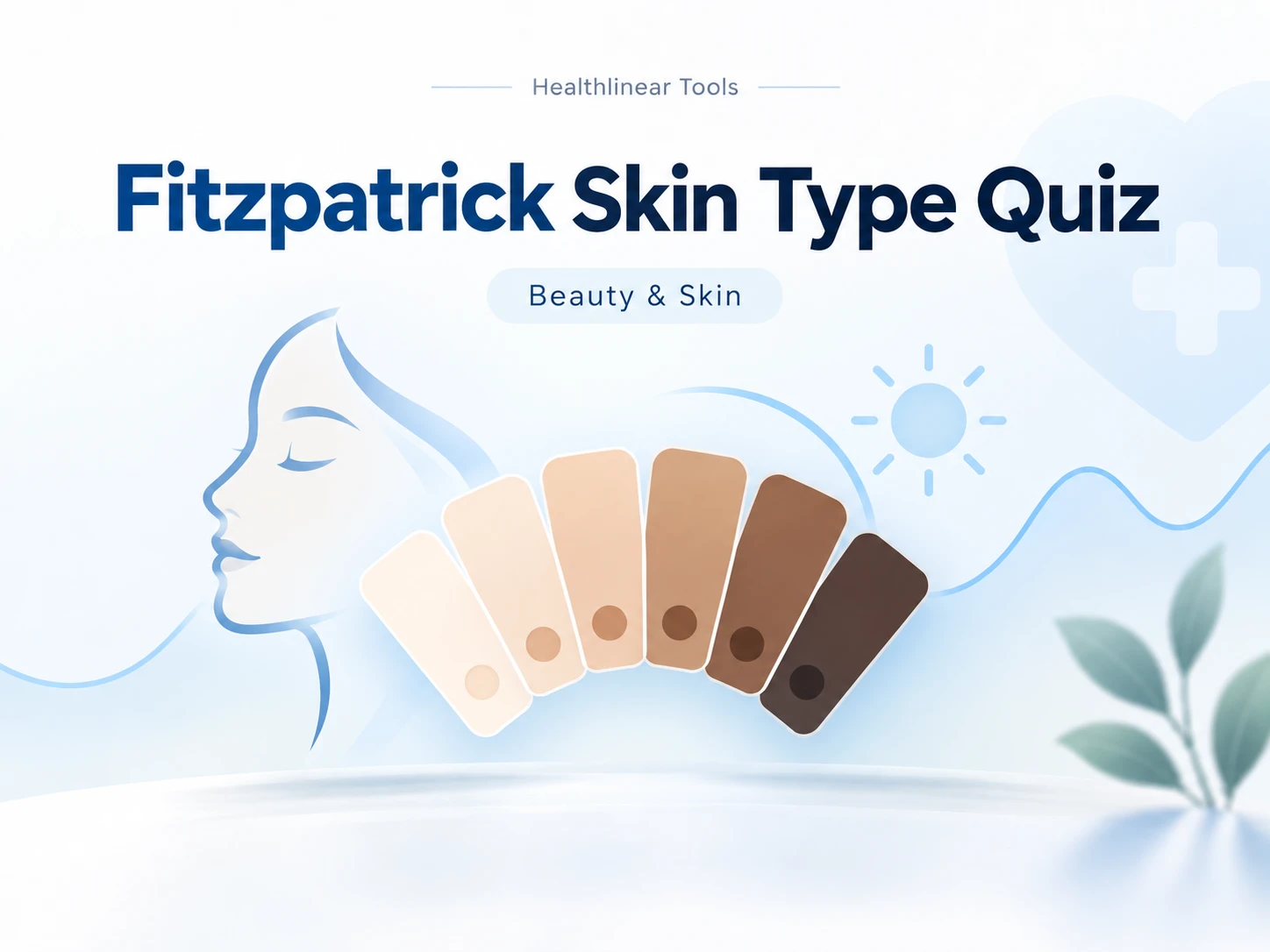
The Fitzpatrick scale is a widely used classification of how skin responds to UV exposure, developed by dermatologist Thomas Fitzpatrick. Knowing your type helps guide sun-protection and skincare decisions — it’s an educational estimate, not a diagnosis or a cancer-risk prediction.
About this quiz: a simplified self-assessment based on the Fitzpatrick skin phototype scale. A dermatologist's assessment is more accurate. Every skin type can burn and develop skin cancer. See our medical disclaimer.
The six Fitzpatrick skin types
Dermatologist Thomas Fitzpatrick created the scale in 1975 to predict how skin responds to ultraviolet (UV) light, originally to dose UV treatment for psoriasis. It was later expanded to six types and is now used for sun-protection advice, laser and light-treatment settings, and skin cancer risk.
| Type | Typical features | Reaction to sun |
|---|---|---|
| I | Very pale skin, often red or blond hair, light eyes, freckles | Always burns, never tans |
| II | Fair skin, light hair and eyes | Usually burns, tans minimally |
| III | Light to beige skin | Sometimes burns, tans gradually |
| IV | Olive or light brown skin | Rarely burns, tans easily |
| V | Brown skin | Very rarely burns, tans darkly |
| VI | Deeply pigmented dark brown to black skin | Almost never burns |
Sun protection by skin type
The American Academy of Dermatology recommends that everyone, whatever their skin type, use a broad-spectrum, water-resistant sunscreen of SPF 30 or higher on exposed skin, reapply it every two hours and after swimming or sweating, and seek shade between 10 a.m. and 2 p.m.
- Types I and II: highest risk of sunburn, melanoma, basal cell and squamous cell carcinoma. Protective clothing, hats and regular skin checks matter most here.
- Types III and IV: moderate risk. People often underestimate this because they tan, but a tan is itself a sign of UV damage.
- Types V and VI: lower burn risk, but skin cancer still occurs and is often diagnosed later, when it is harder to treat. Darker skin is also more prone to hyperpigmentation and melasma, which sun exposure worsens, so sunscreen helps even tone too.
Skin cancer in darker skin
Melanoma is less common in people with darker skin, but when it occurs it more often appears on areas that get little sun: the palms, the soles of the feet, under the nails and inside the mouth. This type, acral lentiginous melanoma, is not caused by sun exposure. A new dark streak under a nail or a changing spot on the sole is worth showing to a doctor. Our melanonychia vs melanoma guide explains what to look for.
Why skin type matters for treatments
- Lasers and IPL: higher skin types absorb more light energy in the skin itself, which raises the risk of burns and pigment changes. Practitioners adjust device and settings to skin type.
- Chemical peels and retinoids: types IV to VI have a higher risk of post-inflammatory hyperpigmentation after irritation, so treatments are usually started more gently.
- Phototherapy: UV doses for psoriasis and eczema are still based partly on skin type.
Limitations of the scale
The Fitzpatrick scale was designed around how skin burns and tans, but it is often misused as a measure of skin color or ethnicity, which it is not. Self-reported answers about burning and tanning are also imperfect, especially for people with darker skin who may rarely experience a visible burn. Researchers are developing additional scales, but Fitzpatrick remains the standard used in dermatology.
Related reading
- Anti-aging skin care: what actually works
- Tretinoin gel vs cream
- Adapalene vs benzoyl peroxide
- Melanonychia vs melanoma
- All beauty and skin articles
Frequently asked questions
What is the most common Fitzpatrick skin type?
It depends entirely on the population. Worldwide, all six types are common, and many people fall between two types.
Do darker skin types need sunscreen?
Yes. Darker skin has more natural protection but can still burn, age from UV exposure and develop skin cancer. Sunscreen also helps prevent dark spots and melasma.
Can my skin type change?
Your Fitzpatrick type is genetic and does not change. A tan temporarily darkens skin but does not change how your skin fundamentally reacts to UV.
Is skin type the same as skin color?
Not exactly. The scale is based on how skin reacts to sun. Skin color is related but not identical, and people with similar coloring can burn quite differently.
Sources
- Fitzpatrick TB. The validity and practicality of sun-reactive skin types I through VI. Archives of Dermatology. 1988. PubMed
- American Academy of Dermatology. Sun protection
- Skin cancer. Centers for Disease Control and Prevention
About this article
Written by the Health Linear Editorial Team from primary sources such as FDA prescribing information, DailyMed, NIH and peer-reviewed studies, which are linked in the article. Last updated October 27, 2026.
Read our editorial process and medical disclaimer. Spotted an error? Tell us and we will correct it.