


Prozac (fluoxetine) and Zoloft (sertraline) are both SSRIs, but they behave very differently in one important way: how long they stay in your body. Fluoxetine has one of the longest half-lives of any antidepressant, while sertraline clears in about a day. That single difference shapes how each drug is dosed, how forgiving a missed dose is, how much trouble stopping causes, and even which drug a doctor might choose after a bad experience with the other.
This guide compares what each drug is approved for, how their mechanisms and half-lives differ in practice, dosing, side effects, discontinuation, drug interactions, and who each may suit, based on FDA labeling.
This is general information, not medical advice. SSRIs are prescription medicines, and switching or combining them should only be done under medical supervision.
Prozac vs Zoloft at a glance
| Prozac (fluoxetine) | Zoloft (sertraline) | |
|---|---|---|
| Drug class | SSRI | SSRI |
| FDA-approved for | MDD, OCD, bulimia nervosa, panic disorder (plus PMDD as Sarafem, and with olanzapine for bipolar depression and treatment-resistant depression) | MDD, OCD, panic disorder, PTSD, social anxiety disorder, PMDD |
| Half-life | 4 to 6 days (fluoxetine), plus 4 to 16 days for its active metabolite norfluoxetine | About 26 hours |
| Typical starting dose (MDD) | 20 mg/day | 50 mg/day |
| Discontinuation symptoms | Uncommon, because the drug clears the body slowly | More noticeable if stopped abruptly |
| Missed dose forgiveness | High, due to long half-life | Lower |
| Pediatric approval | MDD and OCD | OCD only |
What each drug is approved for
Prozac is indicated for the acute and maintenance treatment of major depressive disorder and of obsessive-compulsive disorder, for bulimia nervosa, and for panic disorder with or without agoraphobia. A fixed-dose combination of fluoxetine and olanzapine (Symbyax) is separately approved for depressive episodes associated with bipolar I disorder and for treatment-resistant depression, but fluoxetine alone is not indicated for either of those. Fluoxetine is also marketed as Sarafem for premenstrual dysphoric disorder. It is approved in pediatric patients (generally age 7 and up, depending on the trial population) for MDD and OCD.
Zoloft is indicated for major depressive disorder, obsessive-compulsive disorder, panic disorder, post-traumatic stress disorder, social anxiety disorder, and premenstrual dysphoric disorder. In children, it is approved for OCD but not for the other adult indications.
The practical difference: if the diagnosis is PTSD or social anxiety disorder, Zoloft has an FDA indication that Prozac does not. If it is bulimia nervosa, Prozac has an indication Zoloft does not.
How they work
Both are selective serotonin reuptake inhibitors, meaning they block the reabsorption of serotonin by nerve cells, leaving more available in the brain. Both labels describe the exact mechanism of the antidepressant effect as not fully understood, though it is presumed to relate to serotonin reuptake inhibition.
The meaningful difference is pharmacokinetics, not mechanism.
- Fluoxetine has an elimination half-life of about 4 to 6 days after chronic dosing, and its active metabolite, norfluoxetine, has a half-life of 4 to 16 days. The FDA label states plainly that the long elimination half-lives of fluoxetine and norfluoxetine assure that, even when dosing is stopped, active drug substance will persist in the body for weeks. This has real consequences: after stopping fluoxetine, a person must wait at least 5 weeks before starting a monoamine oxidase inhibitor (MAOI), far longer than the 14-day wait required after stopping most other SSRIs.
- Sertraline clears much faster, with an elimination half-life of roughly one day, so blood levels rise and fall more quickly with each dose and after stopping.
Dosing
Prozac dosing by indication (adult, from the label):
| Indication | Starting dose |
|---|---|
| MDD | 20 mg/day in the morning |
| OCD | 20 mg/day in the morning |
| Bulimia nervosa | 60 mg/day in the morning (often titrated up over several days) |
| Panic disorder | 10 mg/day, increased to 20 mg/day after one week |
The label notes that studies comparing 20, 40, and 60 mg/day with placebo found 20 mg/day sufficient for a satisfactory response in MDD in most cases. A once-weekly delayed-release capsule (Prozac Weekly, 90 mg) exists for maintenance therapy, started 7 days after the last daily 20 mg dose, made possible by the drug’s long half-life.
Zoloft dosing (adult, from the label) typically starts at 50 mg/day for MDD, OCD, and other adult indications, with adjustments based on response, up to a maximum that varies by indication (commonly 200 mg/day).
Side effects
Both drugs share the common SSRI side-effect profile: nausea, diarrhea or loose stools, insomnia or drowsiness, sexual side effects (delayed orgasm, decreased libido), sweating, and tremor. Neither is strongly sedating compared with older antidepressants, and both can be activating (increasing energy, sometimes anxiety) especially early in treatment.
Reported differences between the two in clinical experience and comparative reviews include a somewhat higher rate of gastrointestinal side effects (particularly diarrhea) with sertraline, and fluoxetine’s label specifically notes an average small weight loss in bulimia trials (patients on 60 mg lost an average of 0.45 kg versus a 0.16 kg gain on placebo over 16 weeks), whereas sertraline is more often described as weight-neutral to mildly weight-gaining with long-term use.
Discontinuation: the biggest practical difference
This is where the two drugs diverge most in daily life.
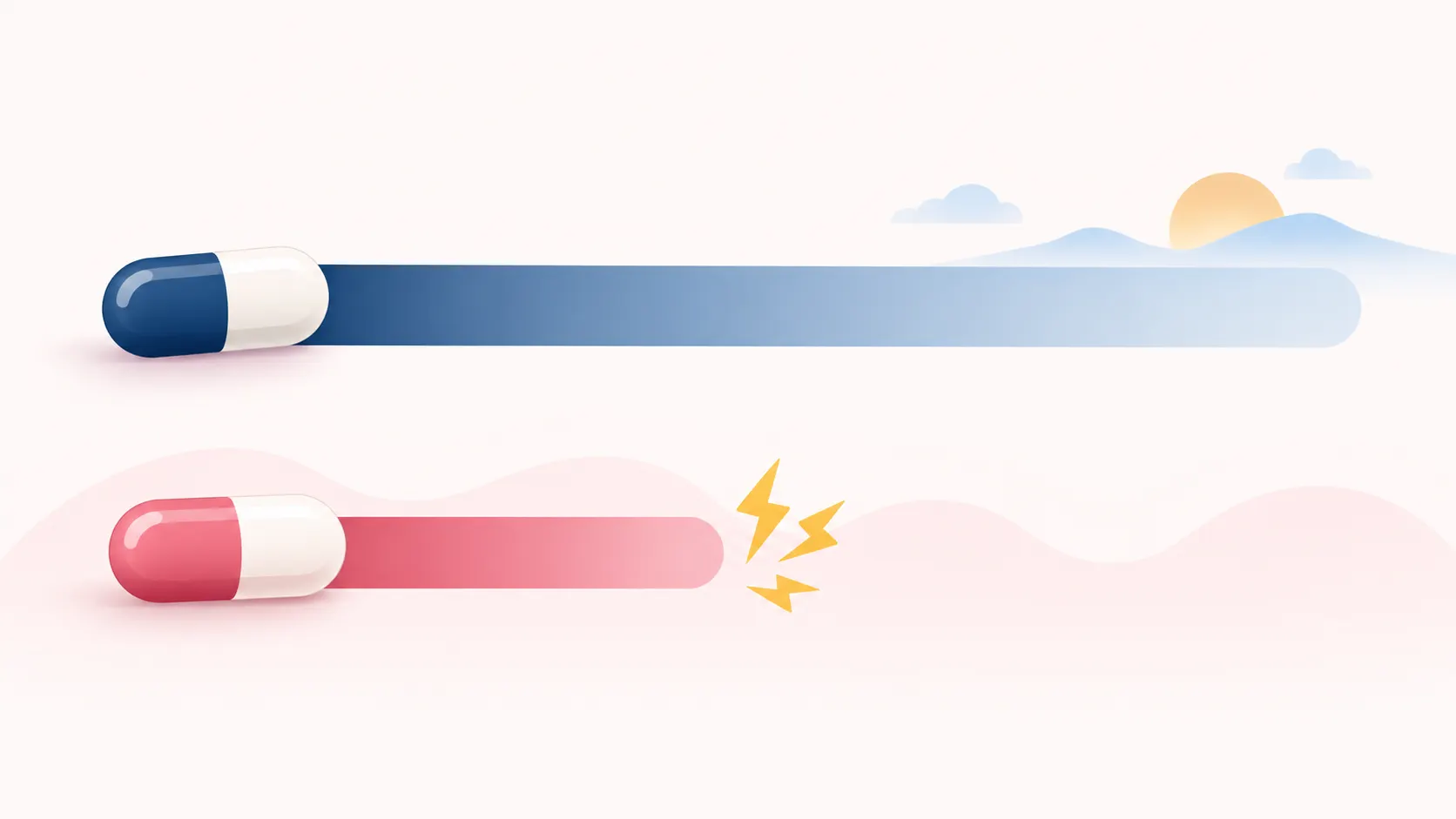
Fluoxetine’s long half-life works like a natural, built-in taper. Because the drug and its active metabolite clear so slowly, blood levels fall off gradually even after the last dose, which is why discontinuation syndrome is uncommon with fluoxetine. A published case report notes that discontinuation syndrome with fluoxetine is rare owing to its longer half-life, though it can still occur, sometimes with a delayed onset (one case described symptoms beginning 13 days after the last dose, precisely because the drug takes so long to leave the body).
Sertraline clears faster, so stopping abruptly is more likely to produce noticeable discontinuation symptoms: dizziness, nausea, irritability, sleep disturbance, and sensory disturbances sometimes described as “brain zaps.” Both drug labels recommend a gradual dose reduction rather than abrupt discontinuation whenever possible.
This difference is also used clinically: doctors sometimes use fluoxetine’s long half-life to help a patient taper off a different, shorter-acting SSRI or SNRI by “bridging” briefly through fluoxetine, since its slow clearance smooths out the drop in serotonergic activity. This is a specialist-guided strategy, not something to attempt without medical supervision.
Missed doses and forgiveness
Because fluoxetine persists in the body for so long, missing an occasional dose has less impact on blood levels than missing a dose of sertraline. This does not mean skipping fluoxetine doses is fine, but it explains why the once-weekly Prozac formulation is pharmacologically possible in the first place, and why fluoxetine is sometimes preferred for patients who have trouble taking a pill every single day.
Drug interactions
Both inhibit certain liver enzymes, but fluoxetine is a notably strong inhibitor of CYP2D6, an enzyme that metabolizes many other drugs, including some other antidepressants, certain heart medicines, and tamoxifen. Because fluoxetine and norfluoxetine persist for weeks, this inhibition also persists for weeks after stopping fluoxetine, which matters when a new drug is started. Sertraline also inhibits CYP2D6 but generally less potently at typical doses, and it also affects CYP3A4 and CYP2C19 to a lesser degree.
Both drugs are contraindicated with MAOIs. The label-specified washout periods differ substantially: at least 5 weeks after stopping fluoxetine before starting an MAOI, versus a shorter, more standard 14-day interval for sertraline. Both interact with other serotonergic drugs (triptans, tramadol, other antidepressants, St. John’s wort), raising serotonin syndrome risk, and both can increase bleeding risk when combined with NSAIDs, aspirin, or blood thinners.
Neither drug should be combined with pimozide, and Zoloft’s oral solution formulation contains alcohol and is contraindicated with disulfiram. See our guide to Zoloft and alcohol for more on that specific medicine’s alcohol guidance, which applies broadly to SSRIs including fluoxetine.
Who each might suit
Factors that may point toward Prozac:
- A diagnosis of bulimia nervosa
- A history of severe discontinuation symptoms on a shorter-acting antidepressant
- A pattern of occasionally missing doses
- Depression associated with bipolar I disorder or treatment resistance, where the fluoxetine-olanzapine combination (Symbyax) is specifically approved (a decision made with a psychiatrist)
- A child or adolescent with MDD, since Prozac has that pediatric indication
Factors that may point toward Zoloft:
- A diagnosis of PTSD or social anxiety disorder, which carry a Zoloft indication but not a Prozac one
- A need to start or stop other medicines that interact with CYP2D6 without a long washout period
- A preference for a drug that clears the body faster if pregnancy is being planned or other medication changes are anticipated
Neither list is a substitute for an individualized conversation with a prescriber, who will also weigh personal and family history of response to either drug, since prior response often predicts future response better than any general comparison.
What the comparative evidence shows
Large network meta-analyses that pool many antidepressant trials, including the widely cited 2018 Cipriani analysis in The Lancet covering 21 antidepressants and over 500 trials, found that most antidepressants, including both fluoxetine and sertraline, work better than placebo, with the differences between individual drugs being much smaller than the difference between any of them and placebo. In that analysis, sertraline was among the drugs with a favorable balance of efficacy and tolerability, while fluoxetine performed reasonably but was not among the top-ranked drugs on either measure. These rankings are useful for population-level guidance, not for predicting how any one person will respond, since individual response varies widely and cannot currently be predicted in advance by any test.
In practice, this means neither drug has a clear efficacy edge established well enough to guide an individual choice. The decision usually comes down to the practical factors covered above: approved indication, interaction profile, half-life, and personal or family history of response.
Pregnancy and breastfeeding
Both fluoxetine and sertraline have been used during pregnancy and breastfeeding, and both have a substantial body of observational data, more than most other antidepressants, in part because they have been on the market longer. Neither is entirely risk-free, and untreated depression during pregnancy also carries risks to both mother and baby. This is a decision made individually with an obstetrician and psychiatrist, ideally before conception when possible, weighing the specific risks and benefits for that pregnancy. Sertraline’s shorter half-life means it clears the newborn’s system faster if discontinued near delivery, which some clinicians view as an advantage, though this is one factor among several in a highly individualized decision.
Practical tips if you are taking either drug
- Take fluoxetine in the morning, since it can be activating and interfere with sleep if taken late in the day.
- Take sertraline consistently at the same time each day, since its shorter half-life means more day-to-day fluctuation if timing varies.
- Do not stop either abruptly without a taper plan from your prescriber, even though fluoxetine is more forgiving.
- Expect several weeks before full benefit, and side effects often appear before benefits do, especially in the first two weeks.
- Report new or worsening suicidal thoughts immediately, especially in the first weeks of treatment or after a dose change, per the boxed warning both drugs carry for patients under 25.
- Tell every prescriber and pharmacist you see which SSRI you take, especially given fluoxetine’s long-lasting CYP2D6 interaction.
Frequently asked questions
Is Prozac stronger than Zoloft?
Neither is generally considered “stronger.” They are both SSRIs with broadly similar efficacy for depression in large comparative analyses. The practical differences are in half-life, approved indications, and side-effect patterns, not raw potency.
Why does Prozac stay in your system so much longer than Zoloft?
Fluoxetine and its active metabolite norfluoxetine are eliminated slowly, with half-lives of 4 to 6 days and 4 to 16 days respectively, compared with sertraline’s roughly 26-hour half-life. This is a fundamental pharmacokinetic difference between the two molecules.
Which has worse withdrawal, Prozac or Zoloft?
Zoloft is more likely to cause noticeable discontinuation symptoms if stopped abruptly, because it clears the body quickly. Fluoxetine’s slow clearance acts like a natural taper, making discontinuation syndrome less common, though not impossible.
Can I switch directly from Zoloft to Prozac or vice versa?
Switching between SSRIs is done under medical supervision, and the approach (direct switch, cross-taper, or washout period) depends on the specific drugs and doses involved. Never switch antidepressants on your own.
Is Zoloft approved for PTSD and Prozac is not?
Correct. Zoloft carries an FDA indication for PTSD and social anxiety disorder that Prozac does not have.
Does Prozac cause weight loss and Zoloft cause weight gain?
Fluoxetine’s label documents modest weight loss in bulimia trials at 60 mg. In general use, both SSRIs have variable effects on weight between individuals, though sertraline is more often associated with weight gain over long-term use in clinical experience.
References
- FDA. PROZAC (fluoxetine capsules) full prescribing information (2017).
- FDA. PROZAC prescribing information: pharmacokinetics and half-life data.
- FDA. ZOLOFT (sertraline hydrochloride) label (2016).
- Kulkarni H, et al. Severe antidepressant discontinuation syndrome. Annals of Indian Psychiatry, 2020.
- Shapiro B, et al. Fluoxetine substitution for deprescribing antidepressants (PMC, 2025).
1 thought on “Prozac vs Zoloft: Half-Life, Uses, and Key Differences”